
Rare and Most Interesting Fine Art Restoration Projects in Progress
Francesco Zucarelli Painting Restoration.
Florence, Italian Rococo 1702-1788, Oil on Canvas, 29" X 38".
Francesco Zucarelli was born in Pitigliano in southern Tuscany, where he initially apprenticed with Paolo Anesi. He then worked in Rome with Pietro Nelli and perhaps Andrea Locatelli. In 1732 he settled in Venice, where he became famous as one of the most desired landscape painters of the classic 18th century. Having visited England on a previous occasion, he was invited by some patrons to return in 1752, remaining there until 1773. He then settled in Florence where he died in 1788.
 Painting Before the Restoration:
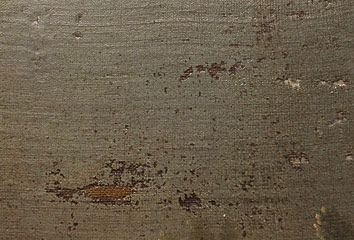
The support is a very thin linen canvas with canvas weft with density, which also resulted in tearing of the fine and brittle canvas and creation of splits with size of a few centimetres all over its area.
On the painting appeared splitting of the colour layer off the ground. Thin, one-layer white oil ground and the colour layer were mechanically damaged with
lengthwise cracks as a consequence of long-term storage.
Almost all breaks and splits in the canvas were unreasonably painted on the back, since somebody in the past probably wanted to prevent the canvas from tearing further in this way. Additionally, there was a vertical 25 cm perforation in the canvas.
 Painting Restoration Details:
Painting is being lined with BEVA 371 using a vacuum hot table.
BEVA 371 is an adhesive used to consolidate and line paintings. It comes in a liquid form, and a film form.
Here a painting is being lined with BEVA 371 using a vacuum hot table. BEVA treatments can be reversed using heat and mild solvent.
 Painting Restoration Details:
Cleaning with organic solvents and scalpel; applications of in-painting techniques: levelling of the surfaces preparation of tempera-based colours and finishing varnishes used in "tratteggio" selection and mimetic techniques; varnishing with organic varnish.
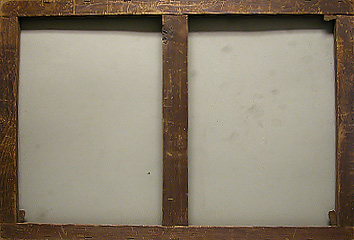 Painting Restoration Details:
Back of the support canvas on stretcher, after lining with BEVA 371, developed by Gustav Berger. An even canvas tension is achieved.
 The restoration and conservation are completed.